
Our Divine Story through Holy Week
During this Lenten season, we’ve made our way with divine story. We found the divine story to be not just about Jesus, but also about our true Origin and our Eternal Life - Christ in us.
We have been invited during Lent to give up and to release the lesser stories about ourselves in order to uncover and embrace more fully our true nature, our divine essence, who we truly are.
Now, we move into Holy Week, looking through the Passion of Jesus into what might be revealed of our own Christophany, in which the Christic unity of ourselves and God is ultimately revealed in Easter resurrection.
In Jesus’ Passion Story, we witness Jesus living the truth of who he truly is, suffering lesser stories of identity, fear, and abandonment. We accompany him until all is released, dead and buried.
How will we be called this week to dwell more deeply in our true essence, surrender our lesser stories, and lie dormant in our true being until we are called to spring to new life?
How will we die to what is false and abide in true essence? How will the tomb’s emptiness generate life anew?
Holy Week Schedule (March 29 - April 5, Easter):
To cultivate a daily devotional practice through Holy Week and through Eastertide, we are offering a recorded meditation to accompany a series of reflections. The daily practice will probably take about 15-20 minutes. We invite you to commit to set aside a regular time every evening (or whenever is best for you), for repetition is the heartbeat of spiritual growth.
Beth Biery and Robert Martin are crafting reflections, beginning with Palm Sunday and continuing with Maundy Thursday, Good Friday, and Holy Saturday. For Easter, a new recorded meditation will accompany the weekly email writings. We hope these daily practices will guide us into a deep divine participation through this Holy Week, perhaps in ways we’ve never before experienced!
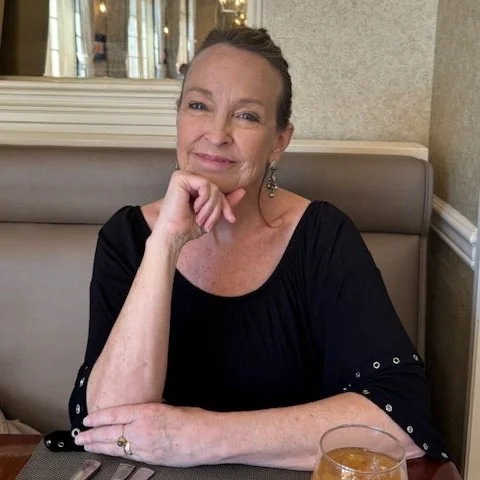
Beth has been in WeSpace and the ICN community for four years — a lifelong seeker finding home here. Family struggles and challenges within the institutional church have shaped her journey of intimacy with God. Roles in family, business, and hospitality have woven her life, including that of kindergarten teacher and spiritual director, with the study of healing and development at the heart. She finds kinship with David’s enthusiasm, the devotion of the Marys, Jesus’ healing presence, and John’s belovedness. The anatomy of interbeing is her newest passion — love, her guiding path.

Robert has been part of the ICN community for 4 years. He has described his experience with ICN as “… a healing balm and blessing for my weary soul. My WeSpace group has been a gracious gift along my spiritual journey.”
In addition to his deep appreciation for ICN, Robert brings 30 years of professional experience as a seminary professor and ordained clergy.
Please look for these ICN emails, with 2 short reflection questions and a link to a recorded meditation:
● Sat, March 28: Palm Sunday
● Wed April 1: Maundy Thursday (Lord’s Supper)
● Thurs April 2: Good Friday (crucifixion)
● Fri April 3: Holy Saturday (entombment)
● Sat April 4: Easter (resurrection)
Palm Sunday with Our Divine Story
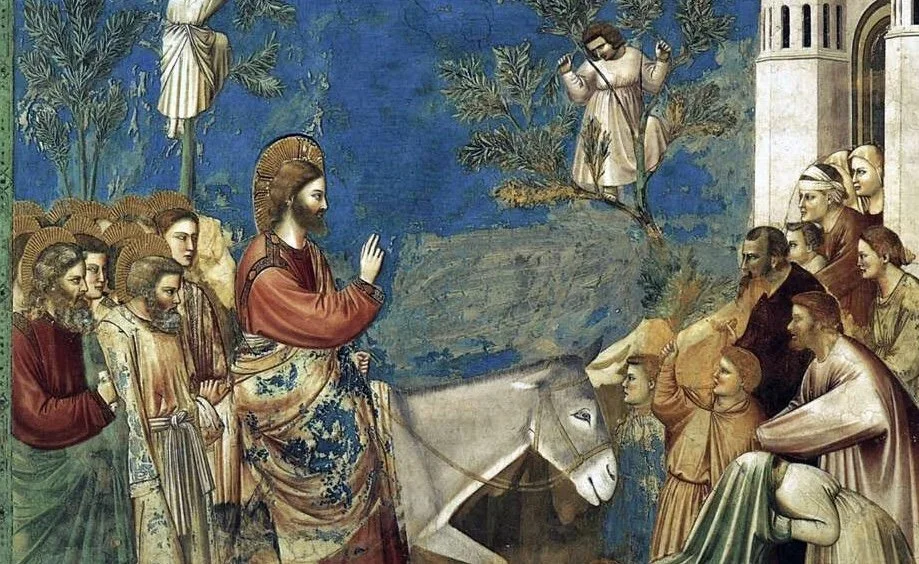
“The Entry into Jerusalem” by Giotto di Bondone
Palm Sunday marks the beginning of Holy Week, the most hallowed of weeks in the Christian year. It begins with Jesus riding a humble donkey into Jerusalem, an epicenter of religious and political power. Crowds line the dusty road waving palm branches and jubilantly crying “hosanna!” to this prophet and healer, this hoped-for messiah and future king.
Although Jesus was revered by many, he was also reviled by others. He was called a charlatan, blasphemer, and rebel. As Jesus approaches Jerusalem, wildly competing stories swirl around him amidst high-pitched religious fervor and quiet, deadly governmental suspicion. His enemies plot to eliminate him.
Even those closest to him - his own family and disciples - wonder who he really is and how he fits into “the way things are supposed to be”, and that confusion of stories will play out tragically during this Holiest of Weeks in acts of calculated betrayal and heart-wrenching denial.
Jesus’ entrance into Jerusalem, riding on a lowly donkey to the fickle adulation of people who are desperately hopeful, signals a scriptural “week” of agonizing struggle as Jesus wrestles mightily with his true identity in God. Years earlier, during his baptism in the Jordan River, he heard a resounding pronouncement from his divine Father:
“This is my son, the beloved, in whom I have delighted.”
At every turn of his three-year ministry, Jesus strived to keep his true origin - his divine origin as a beloved child of God – distinct from all of the noisy lesser stories swirling within and outside himself. Jesus struggled passionately with who he really was and what God was doing in and through him, as his own “Lenten” journey in the desert showed.
His “Passion” led him through Jerusalem’s adulation and treachery straight to the garden of Gethsemane, where alone in such fear and agony, he sweated blood.
His “Passion” led to a horrific crucifixion, ending with a cry of abject despair: “Why have You forsaken me?!”
At that dreadful and final moment, did he question his origin story? Did he lose faith? [We will take this up in the Good Friday reflection coming this Thursday.]
Looking through Jesus’ Passion into the Truth of our Passions
We know how Jesus’ journey of passion ends in Holy Week: a grizzly, horrific death and the terrifying emptiness of the tomb. And after that….resurrection. As we read the Passion story, if we are not careful, we can let the drama of Jesus’ suffering blind us to ways that our lives are reflected in Jesus’ life.
But if we are in Christ – as the Scriptures attest – then we can and should find our story in his story. And so we do….
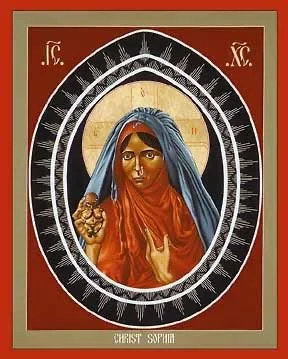
"Christ Sophia" by Br. Robert Lentz
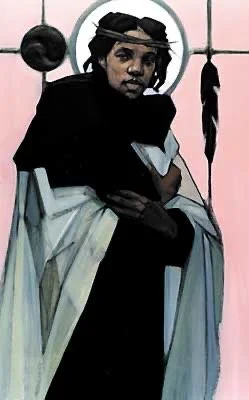
"Jesus of the People" by Janet McKenzie
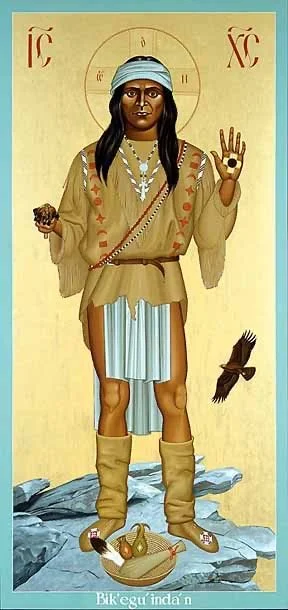
"The Apache Christ" by Robert Lentz
To wrestle with competing stories about oneself is a thoroughly human predicament. From our very first days in this world, we are told where we come from, why we are here, and what we are supposed to do. Jesus struggled with his identity just as we do.
Messages to us and about us are complex, often contradictory, and usually dissociated from our true and divine origin:
as a beloved child of God,
the continual Source and Sustainer of our existence,
the eternal One in whom we live and move and have our being,
regardless of where we are, what we do, or what is said about us.
This Holy Week in 2026, let’s journey with Jesus into Jerusalem and toward the tomb. But let’s do something a little different: let’s try to set the ‘horror’ aside for just a moment. Let’s reimagine with a curious mind and an open heart what is happening underneath the drama – perhaps even hidden by the drama.
For all of us are on our own journeys, moving in and through our own “jerusalems,” eventually directed toward our own tombs. Perhaps our way of journeying is loud and dramatic; perhaps soft and subtle. For some, passion/suffering is intense and fierce; others may have an easier way, for now. Some “jerusalems” are rife with conflict or tragedy, but some of us feel our communities as gentle and supportive.
The circumstances of journeying will vary widely from person to person, from moment to moment. But what characterizes each person’s journey is that we have all kinds of stories swirling around us and within us, telling us who we are and what we’re supposed to do. Stories from our past that keep haunting us; expectations of how we’re supposed to be; what is wanted from us. The press of these stories on our hearts and minds can be suffocating.
Our Divine Story
But like Jesus, we have a divine origin story that is more fundamental and more true than any other story. It is an eternal origin story, and we share it with Jesus, and we share it with the rest of creation:
We are God’s children –
we are being continually created and sustained by God, no matter who we are or what we do;
we are beloved, no matter who we are or what we do.
Luke described this a couple weeks ago:
“Through the spiritual womb of God, the Divine Mother, we are continuously born of the eternal, from the Source of all life, unbroken and undivided. Before and after. Beyond time. Ever-rooted in the eternal divine essence of ultimate wholeness and unceasing, infinite love.”
As we journey through our “passion”, through our “jerusalems”, and toward our own tombs, as the “dust” of our existence gives way in death, “who we truly are” is held safely and securely in the One in whom we always and evermore live and move and have our being.
This is true no matter if we know it or not.
It is true whether we believe it or not,
whether we have ‘faith’ or not.
The simple fact of our existence is that we live and die in a God who delights in us.
Every other story is less than our eternal, divine origin story; every other story bows to its sovereignty. No matter who we have become, no matter what we have ever done, no matter what our circumstances are or will be: we live and move and have our being in God.

We live
and move
and have our being
in God!
Let yourself sink into that reality, into that realization. Rest in it. Dwell deeply in it. And let go of every other story about you.
How? How might we let go, and at the same time, dwell deeply.
Well… it’s not as straightforward or as easy as it may seem.
Letting Go and Going Deeper
Letting go of something may seem pretty simple. You just… let….go. But the complicating and frustrating thing about releasing is that the more important it is to us, the more difficult it is to let go. And the more effort we put into letting go, the stickier it becomes.
This is especially true of thoughts we have. If we are anxious about something, for example, it’s really difficult to make ourselves let go, to release that anxiety. And the more we try to not think about it, the more we can’t not be anxious.
This is all the more true of stories we tell ourselves; and the more significance the story has, the harder it is to let go. Whatever we believe about ourselves - that we are good/bad, right/wrong, liked/hated, perfect/deformed - if we believe it is really true, it is almost impossible for us to release those stories. We can deny them, hide them, ignore them, or distract ourselves but no matter our effort, those beliefs are chained to us. Force of will alone can’t win this power struggle.
The only way we can be freed from our lesser, sticky stories is for our attention to be attracted to a more compelling reality. And only repetitively.
When I was just 3 or 4, my big brother took me to the local public pool. It was so huge with a cacophony of kids swimming and splashing and yelling. I was overwhelmed and scared to death. I hung onto the side for dear life; no way was I going to let go!! So, my wise brother lured me instead to the “beach” end of the pool where the babies were playing. He started throwing ball with me; we threw it harder and farther, back and forth, laughing and splashing ever so sneakily into deeper water. At some point, I looked around and realized that I wasn’t holding onto anything. He smiled knowingly at me; in return I threw the ball hard at him, and little by little we played our way toward the deep end.
To let go of the stories to which we grasp, by which we “survive”, we need to focus our attention on a more compelling story, a truer story. One that resonates within and draws us deeper. To go deeper, we let go, not because we have to, not because we make ourselves let go.
We let go because the Truth is more compelling,
and we desire it more;
it is more satisfying to spirit and soul.
We shift the focus of our awareness: we simply and effortlessly turn away from the lesser things to behold the greater, the truer.
A refocusing of awareness does not happen all at once; it is a gradual, incremental undulation between our habitual focus on the lesser and shifting our attention to the deeper, the truer. Over time, the process of letting go and going deeper becomes our new habit, and the process feels more natural, more easeful.
Practicing Letting Go: Daily Examen and Meditation
To practice letting go and going deeper, we developed a daily (or perhaps even more often 😉) discipline of reflection and meditation to journey through Holy Week and into Easter.
Our discipline this week involves 2 questions for us to reflect on, and a recorded meditation to guide us through the process. This is a way we can step into a dedicated habitualizing of letting go of things to which we grasp and abiding more deeply in the two-fold Truth of our being:
a) that we are always in God and God is always in us;
b) that we are always and forever beloved.
Holy Week Examen and Meditation
To accompany our journey of Passion this Holy Week, you are encouraged to practice this reflective and meditative discipline regularly. The questions are modeled after the Ignatian examen, and are oriented toward an evening setting. Take a couple minutes to ponder and write your reflections on these questions in a journal or tablet. No need to over-think; all reflections are welcome. Then when ready, start the recorded meditation.
What lesser story did I experience today?
How did I experience being centered and grounded in God today?
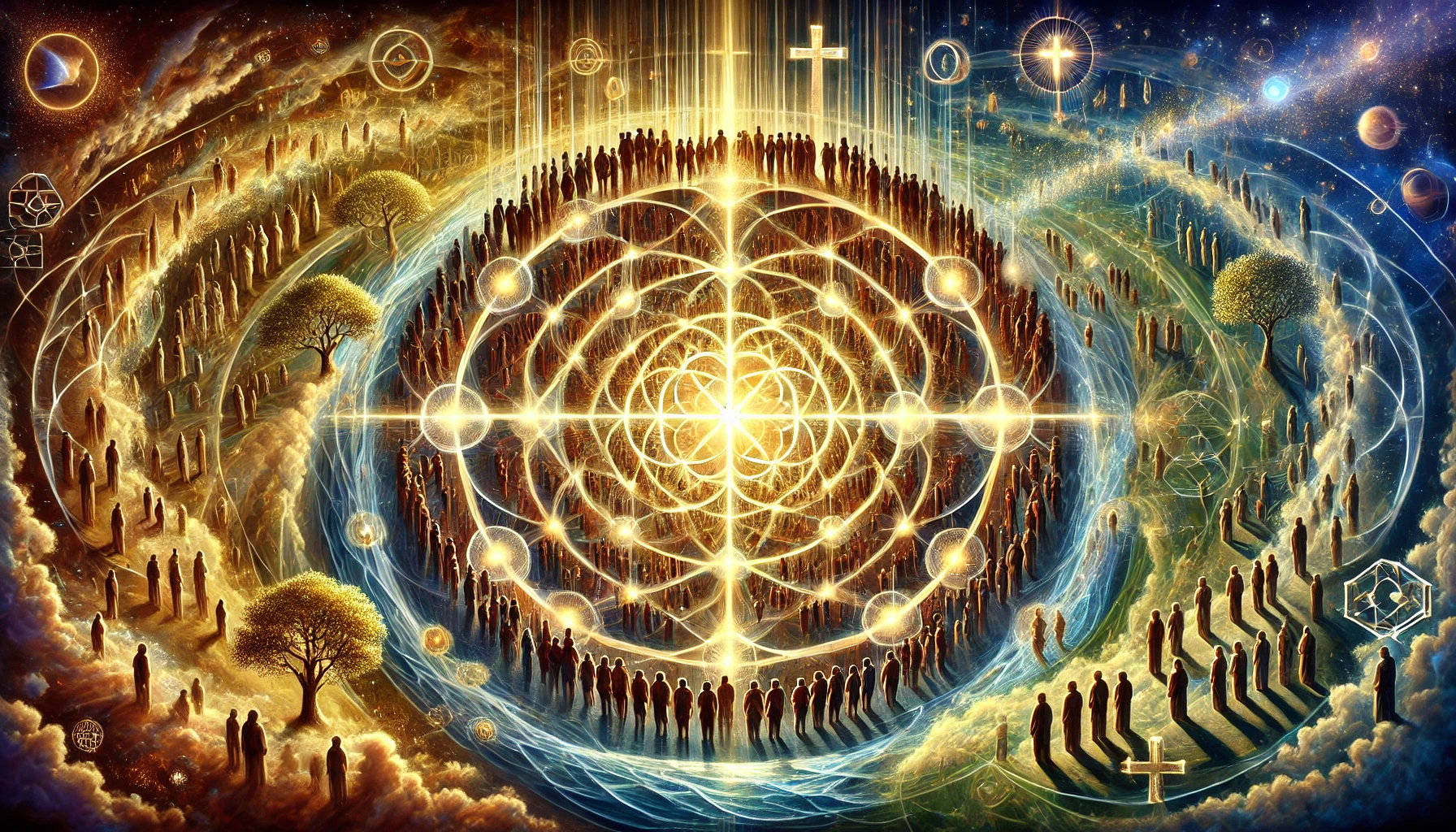
This is the Christ Logos, the universal pattern of God’s creativity still coming into being, every and always.
And it is our divine WeCreating invitation.
To sing the song of love in the world, composed from nothing less than the Living Origin of eternal wholeness and union in God.

The March 2026 WeCreator newsletter is here!
This edition shares a community update from our Board Presider as we hold Luke and his family in this sacred time of welcoming new life, along with reflections on how we continue to WeCreate together in the weeks ahead.
You’ll also find a glimpse into the ongoing unfolding of our Leap200 journey, stories of generosity within our community, and an invitation to share your own experience through our “Testaments.”
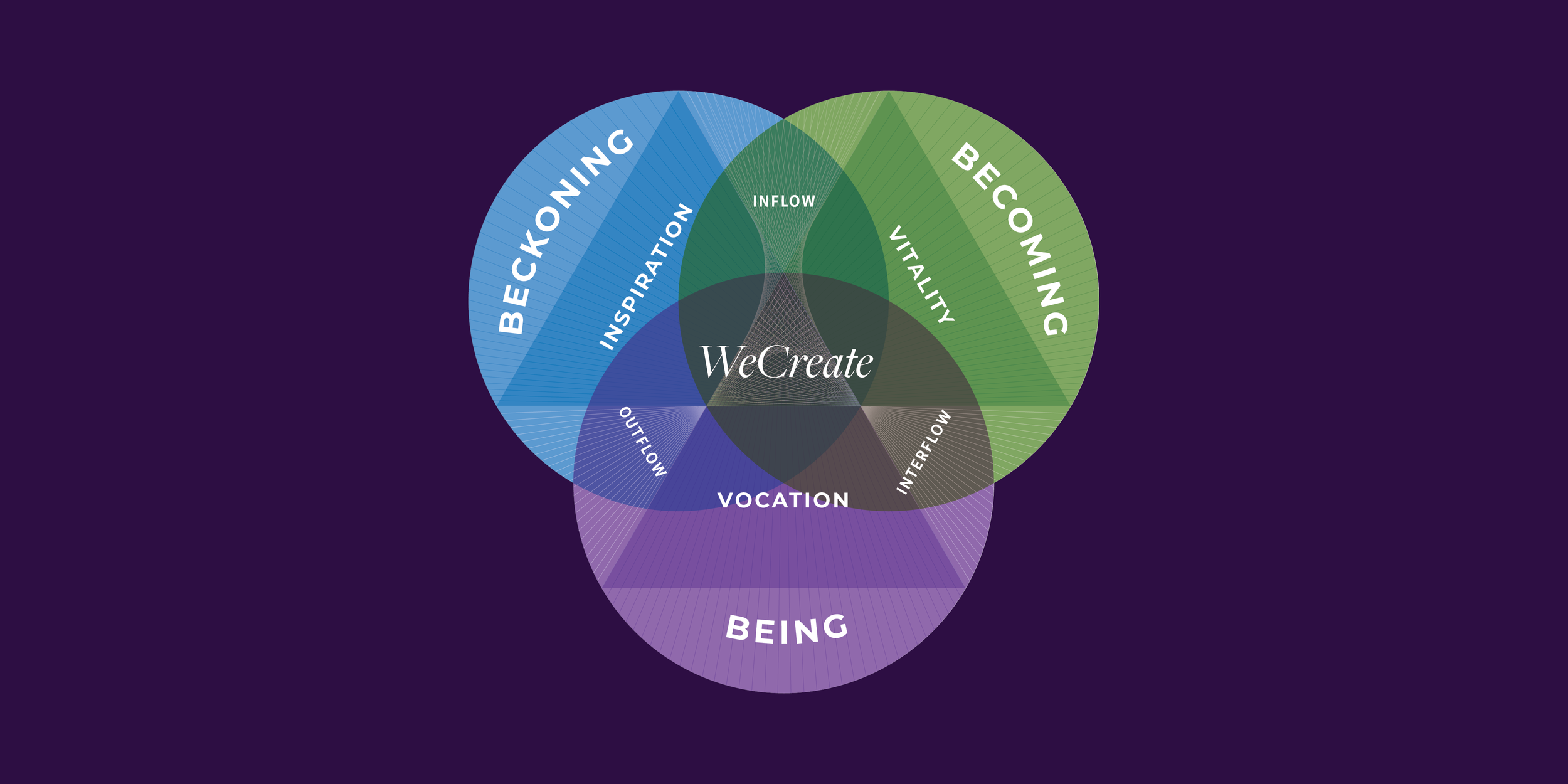
Statement of WeCreating Authorship
This article was WeCreated with authoring by Robert Martin and Beth Biery, with editing support by Luke Healy.
All of the wisdom, creativity, and spiritual emergence in ICN comes from the communal field of wisdom and spirit speaking in and through the “We.”
All text in this article is human-authored without the use of AI beyond light editing, according to our AI policy: 1 out of 10
All Images are open-source, used with permission, or created by ICN with the use of AI