
The Great (misunderstood) Commission

Embodying Resurrection
In Eastertide
(50-day period from Easter to Pentecost)
This is the final Eastertide reflection, examen and meditation. Beth Biery and Robert Martin have enjoyed wecreating the offerings, and we hope they have been a blessing to you.
A new midweek email is coming out, called “Community Connection” with three main sections:
“Becomings of the Christophany Choir” in which community members share stories of living into their resurrections.
The daily examen and meditation in one place for easy access.
Opportunities for Community participation and contribution.
**Please look for it in your spam/junk folder if it is not in your inbox.
If you haven’t yet read the reflection on Easter Sunday, we invite you to do so. It sets the stage for our subsequent reflections in Eastertide. Its main theme was articulated by pan-Christian theologian Raimon Panikkar:
resurrection is not limited to [Jesus] alone,
it is the vocation of all of us….
Resurrection is ours, it is now.
During Eastertide, we will reflect on the resurrection of Jesus for insight into how we might live into our resurrections (renewals) more fully.
The Great (misunderstood) Commission
Acts 1
…while he was eating with them, he gave them this command: “Do not leave Jerusalem, but wait for the gift my Father promised, which you have heard me speak about. 5 For John baptized with water, but in a few days you will be baptized with the Holy Spirit.”
8 But you will receive power when the Holy Spirit comes on you; and you will be my witnesses in Jerusalem, and in all Judea and Samaria, and to the ends of the earth.”
9 After he said this, he was taken up before their very eyes, and a cloud hid him from their sight.
10 They were looking intently up into the sky as he was going, when suddenly two men dressed in white stood beside them. 11 “Men of Galilee,” they said, “why do you stand here looking into the sky? This same Jesus, who has been taken from you into heaven, will come back in the same way you have seen him go into heaven.”
Growing up in Louisiana as a Southern Baptist, the ascension of Jesus was a big deal. It was regularly preached on, and everyone wished they could have been there to see Jesus lifted up into the clouds. What a sight that would have been!!
But inevitably the preacher would bring up the rapture, and quote the angelic visitors from the Acts 1 passage – “[he] will come back in the same way you have seen him go into heaven” – and all of us would for the next week or so constantly stare into the sky for any sign of Jesus floating back down into the clouds to call all the faithful (all of “us”) to join him in heaven.
Most of the preaching I’ve heard since then still focuses on the spectacle of Jesus rising magically, up up up, and on the complex emotional state of the disciples as they watched him in awe, up up up. Once again, I’d like us to try a different perspective as we reflect on this passage:
How did resurrection change Jesus?
And what might that mean for us
as we are changed by our
passing from death to new life?
Dying to Making Others in Our Own Image
More than being a spectacle and filling the disciples with awe, I believe this passage reveals one of the most unexpected Truths of the Divine Life as it is intensified and clarified through resurrection experiences. And that Truth, disclosed in Jesus’ life, death, and resurrection, directly contradicts all forms of Christianity that seek to make others into its own image. This includes all forms of Christendom that project mission imperialistically, that imposes ritual, doctrine, practice, or style of life on other people.
I realize how direct this is sounding, and I say it with humble trepidation. But it seems clear that imperial Christianity is a mighty force of cultural polarization and conflict sweeping the globe and seated firmly in the United States. One of the roots of this world-wide hostility is the “Christian” Great Commission (other religions and philosophies have their own imperialistic commissions).
The Great Commission and its derivations in other scripture passages is closely tied to the Ascension. It is the last instruction that Jesus gives the disciples before being taken up. Matthew 28 contains the version of the Great Commission that I heard the most:
go and make disciples of all nations,
baptizing them in the name of the Father
and of the Son and of the Holy Spirit, 20
and teaching them to obey everything
I have commanded you.
We Southern Baptists took it literally and vigorously. We tried our best to make others into our image of what disciples should be. And in so doing we were rather obsessed with the obedience-to-commandments part.
Too bad the entire effort was (and still is) misguided by a fundamental misunderstanding of our relationship to God, what discipleship is, and how it is fostered.
By looking at Jesus as resurrected, we see that resurrected life is inherently missional. Jesus goes to where the disciples are, heedless of distance, unhindered by locked doors, undeterred by the past.
True Mission as Co-Mission
But we need to understand “mission” biblically. If we look to the Gospel of John for guidance, we notice that the book begins by proclaiming that all things everywhere are created in and through the Logos of God, constantly created here and now. That is, the Divine is already in everything – people, animals, vegetation, rocks, space and time, etc.
This universal Divine ontology means we can’t impose God on anyone or anything because the Creator is already there. If we try to impose God on anyone, that simply indicates that we don’t have a clue Who and What God is and how we are related.
John portrays God as infinitely beyond us and intimately within us, that we are unified with God just as Jesus is unified with the Father. And this unity is manifest as communion: a sharing of all things, sacrificially creating abundance, especially with the “least of these.” It is never about making others into our own image. Rather, the mission of Divine Life is to manifest in and through us, always seeking to commune with the manifestation in others, as from heart to heart, center to center.

Living in Resurrection Unity
So, being a disciple, a follower of Jesus, is to be resurrected into this communal unity. Passing through death to new life not only deepens and intensifies our participation in the Divine, it also extends and invokes it with others. Thus the Divine Mission is always co-mission. It is a Great Commission of Communion.
Indeed, I think a much better and accurate translation of Matthew’s Great Commission would read: go and “disciple all nations” or better yet, “be discipled with all nations.” It is a call to transcend all barriers that separate or polarize us so that we may more fully embody Christ, together. As a result, we can’t make disciples; rather, we disciple one another; we are discipled with one another as we share everything we are and have, and lift up those who are put down.
In this way, growing in discipleship is nothing less than Divine Communion taking human form in the power of the Spirit. Such communion is a baptism with the Holy Spirit, a continual immersion in the Divine Life such that God becomes us… becomes you.
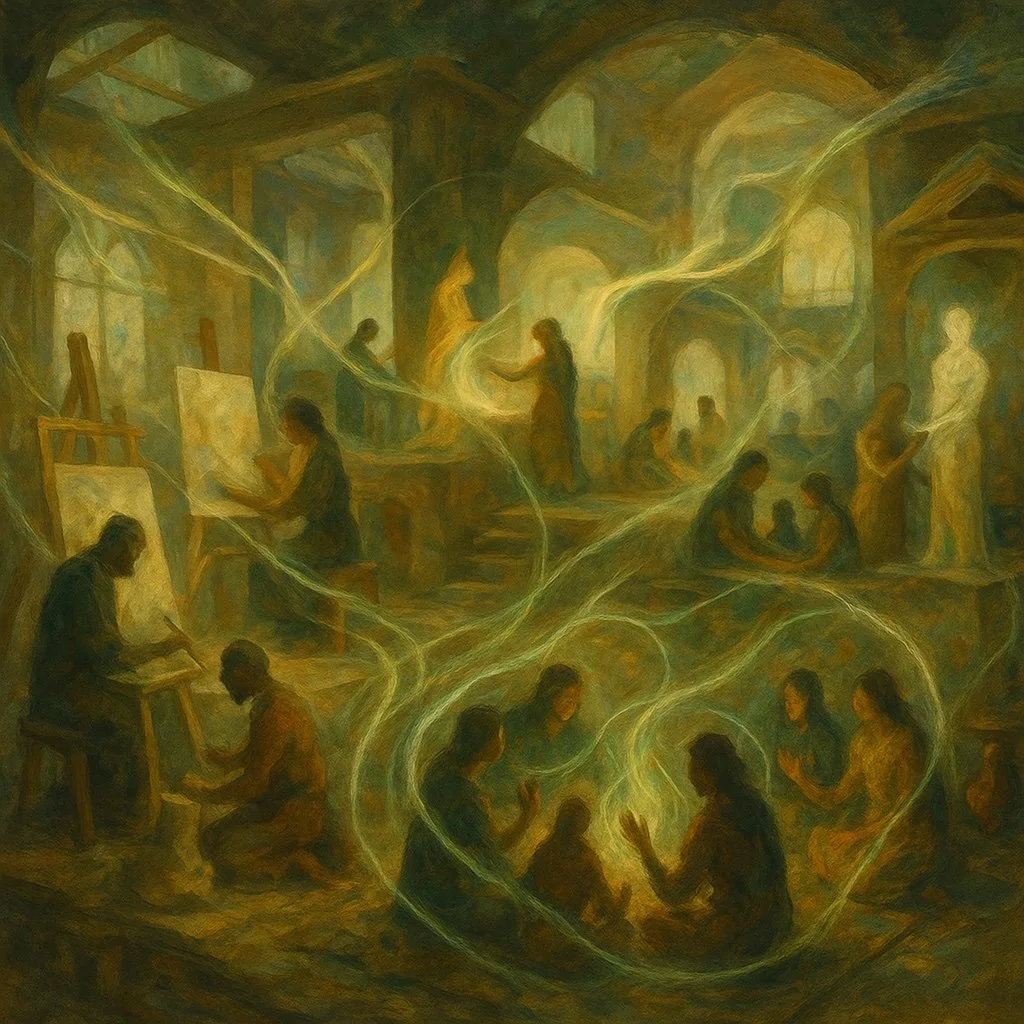
Manifesting Communion
That is how we become witnesses of the Way of Jesus.
That’s how we follow Jesus: Being immersed ever more deeply in the Divine Unity.
That’s how we disciple each other and all nations:
by living out Divine Communion every moment, in every relationship:
sharing all things,
generating greater abundance,
blessing especially the lowly in spirit, in body, in society, and in nature.
Dwelling in Our Resurrected Being
Living on the Other Side of the Stone
Eastertide Examen and Meditation
To help us settle into and naturalize our resurrections, we offer a short examen reflection and a recorded guided meditation. We hope that the practice of reflection and meditation will be a daily discipline for you, for it is only through regular repetition that we are spiritually formed by our resurrections. Otherwise, if only episodic, resurrection power fades and we revert to default patterns.
We live out our resurrections through consistent, regular practice.
We invite you to enter into these meditation exercises as regularly as you are able. The questions are modeled after the Ignatian examen. Take a couple minutes to ponder and write your reflections on these questions in a journal or tablet. No need to over-think; all reflections are welcome.
Examen Questions:
How have you shared your life today?
How have you been surprised by communion?
How is Resurrection changing me?
When ready, start the recorded meditation.

Consider incorporating the Examen and Meditation in your WeSpace groups.

Statement of WeCreating Authorship
This article was WeCreated with authoring by Robert Martin and and light editing by Beth Biery.
All of the wisdom, creativity, and spiritual emergence in ICN comes from the communal field of wisdom and spirit speaking in and through the “We.”
All text in this article is human-authored without the use of AI, according to our AI policy: 0 out of 10
All Images are open-source, used with permission, or created by ICN with the use of AI