
Holistic Trust with “The Other”

“The Pattern Itself”
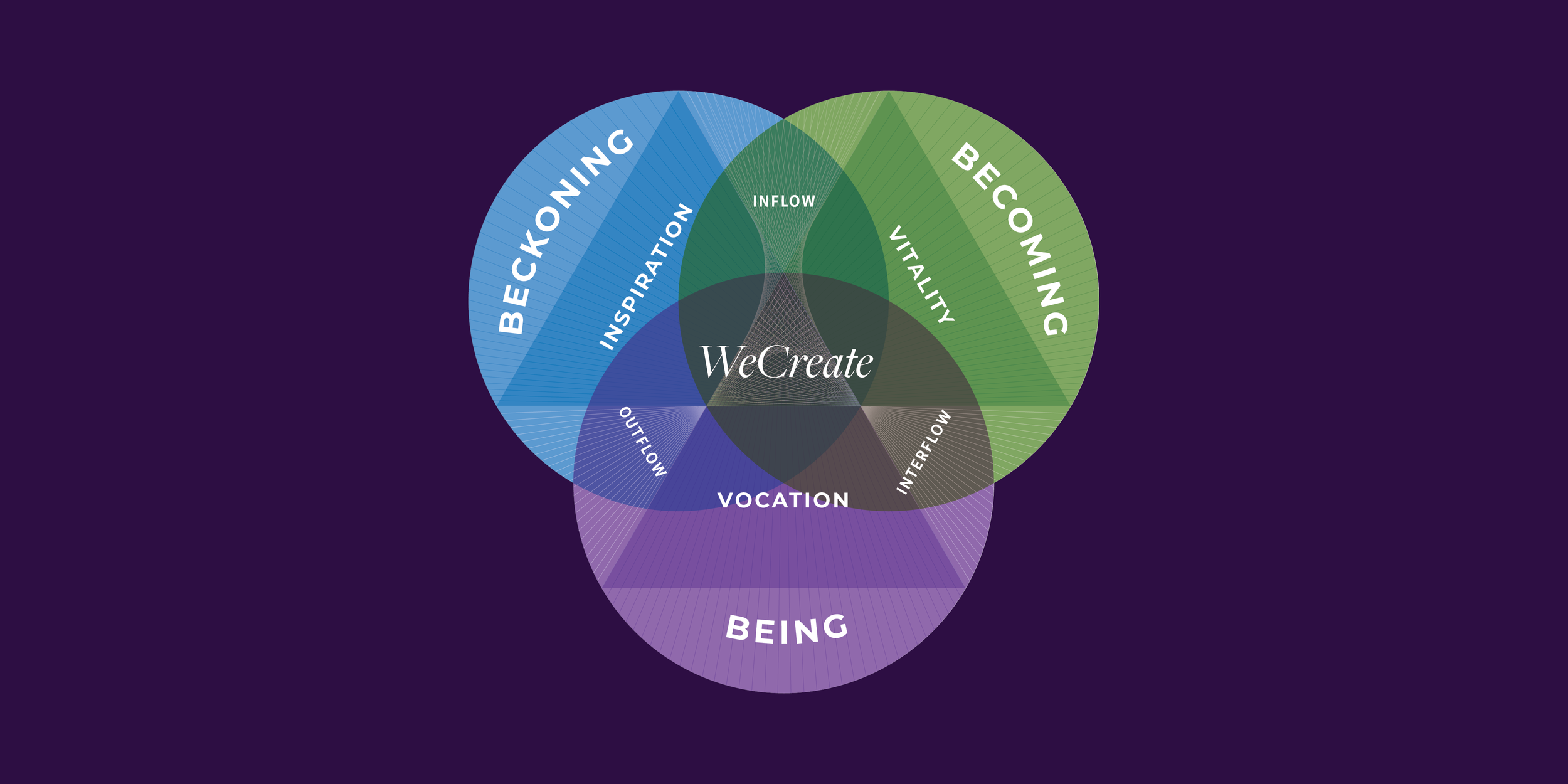
This week’s rhythm of loving evolution: Beckoning
We are offered a lure from Spirit, a call of the divine, an invitation to learning, opening, and hearing how God is beckoning us to become and be in new and deeper ways.
As you read this article, you are invited to listen for how spirit is beckoning you—and us, communally—into our divine participation and WeCreating the loving evolution of Christianity and the world.
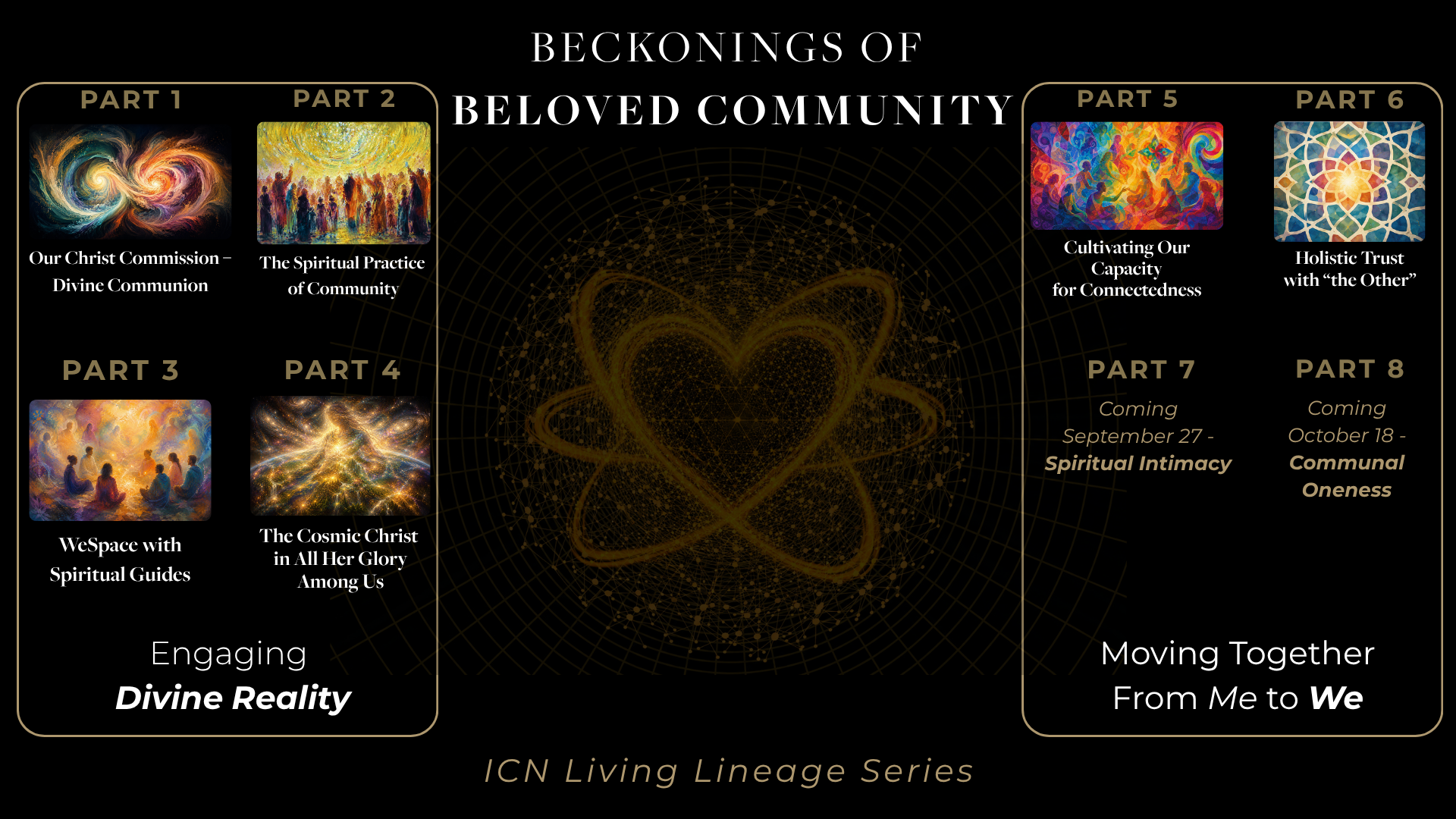
Beloved Community – Part Six
ICN Living Lineage Series
We are exploring the two fundamental orientations of how we practice mystical, living community in ICN. The first is the divine reality of our communion, which incorporates both the physical earth and cosmos, as well as spirit guides and non-physical beings. Our beloved community is not just a beneficial human reality, but one of cosmotheandric wholeness—the seamless fabric of all reality divine, human, and material.
Our second fundamental orientation is the ongoing recalibration of self-referentialism giving way to healthy and effusive mutuality. This very much includes our particular precious personhood, more released from the barriers of individualism and the restrictive boundary markers of tribalism. This is essentially the movement from me to we.
As we are growing in our capacity for connectedness, we come to find again and again the vital and crucial foundation of holistic trust, to which we now turn.

“The Living Interweave”
Deep community cannot happen without trust. And trust is a tricky thing. How do we choose who to trust? How is trust built? What if we over-trust and innocently subject ourselves to something harmful? What degree of trust is appropriate for relationships in spiritual community?
It is most often the case that trust comes in degrees and builds over time. We are regularly, consciously or not, gauging situations and judging whether or not they are safe, whether a person is trustworthy, whether to take a step forward or a step back. Our instinctual encounters with “others” often come from a default place of caution, perhaps even mistrust.
And we can have good reasons for this. We have been hurt before and we don’t want to be naïve. Our evolutionary conditioning of threat assessment continues to serve us well in our lives in many ways. But we won’t make it very far into practicing community if this is our standard, default posture.
Stepping into community is always a movement of vulnerability. This requires us to be with our fear of “the other” and the unknown, while also embracing the risk that comes whenever we put ourselves out there, whenever we choose to love, whenever we open up. This is a step of faith.
Faith is akin to trust, but welcomes the unknown and the unproven. We should be discerning in where we place our faith, but our steps forward in faith often ask us to go beyond where we are comfortable, where we feel most safe, and into the mystery of “other.”
It’s a difficult balance to be sure. It’s what Jesus spoke of when he told his followers to be as wise as serpents and as innocent as doves. It is a paradox of faith.

“Beneath the Surface”
Holistic trust will first begin with a fundamental faith in God, which we must remind ourselves is not a celestial Zeus pulling the levers to make things work out or not, but a divine presence that is always with us in love. An inner being deep within that is always becoming through us. A great beautiful mystery that is always beyond what we know and can grasp. And we trust that God is at work in the world, in our communities, and in us—even when things don’t work out how we might have wanted them to. This is the common Source that flows under the space between us.
This trust also will need to be placed in ourselves as well. For some, this can be harder than trusting God or others. If we don’t trust ourselves, we will look for it in others and place too much faith in them. This might seem like trust in another, but it is not a healthy mutuality. Maya Angelou speaks to this saying, “I don’t trust people who don’t love themselves, but say I love you.” She quotes an African proverb “Be wary of the naked man offering you a shirt.”
With a base trust in ourselves (not without our doubts of course) and a trust in God present in the world, in others, and in ourselves (again, doubts welcome in the paradox of faith), we can begin to discover a deeper trust in “the other.” A more holistic trust born out of deep mutuality and communal resonance.
Recognizing that Which Sets Us Apart
In the traditional sense, trust is something that comes gradually and must be earned before it is given. This comes from a fundamental base understanding of separateness. Of something that doesn’t exist yet already but might come to be, given the right circumstances and steps taken by both parties.
It’s important to acknowledge that this is the assumed baseline. The forces of disconnection are so strong in our world today, especially in western culture, that we are constantly put in the place of being against and apart from one another. This posture is fueled by forces like narcissism, jealousy, egotism/pride, competition, deceit, nationalism, scarcity-mindset, fear, empire-building, and other pathological forms of ways of being so common today.
Our most common systems, politically and economically, draw upon these forces and reinforce isolated identities that make our neighbors into ideological enemies or competing adversaries to win against. The “other” as obstacle to be defeated, which always leads to violence of one form or another.
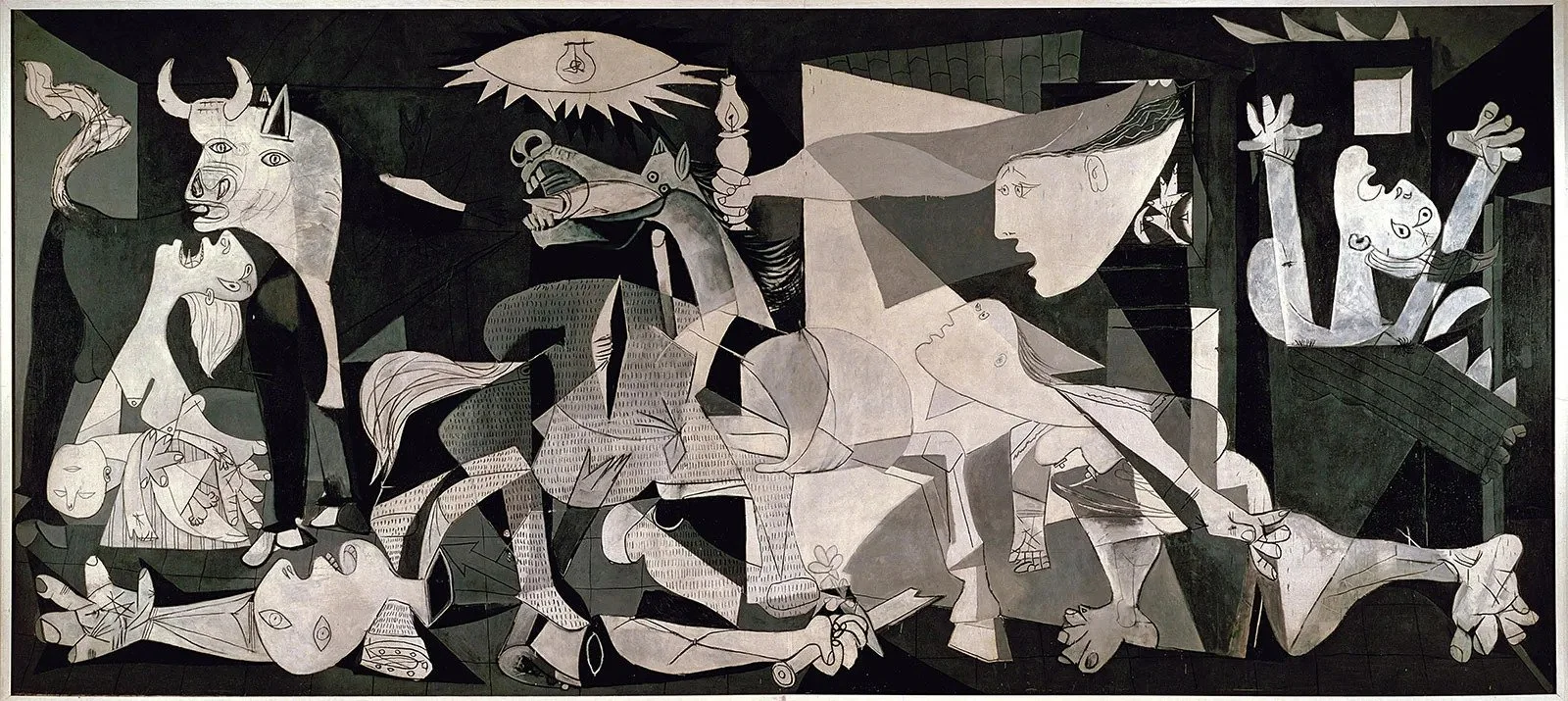
“Guernica” by Pablo Picasso
This “othering” not only keeps us apart from each other, but from ourselves as well. The other, whoever that is, becomes the scapegoat onto which we project the tension and conflict we feel inside ourselves. We see this happen across the lines of political party, religion, nationality, race, or any other division that might be called upon. It could be as benign as the neighbor’s messy or way-too-clean yard. Or the coworker who is more productive or slacks off too much.
There is always “the other.” And no community can be built around only those who have proven trustworthy, do everything right, or meet all of the standards we hold. If we try to “purify” the in-group, we simply come to resent the least common denominator or scapegoat the weakest link—according to whatever self-standards we have come up with (often “baptized” by selective scriptures, segments of tradition, or manipulative declarations from authority). We think we are protecting, but actually we’re drawing upon the forces of disconnection.
As a common proverb reminds us, “We have met the enemy, and it is us.”
And so we know that the answer is not through narrowing the tribal boundaries, dividing into another faction of identity through religion, politics, vocation, or nation. But to discover a deeper trust and mutuality that transcends these divisions—or rather, lies underneath them.

“From the Root”
Mystical Trust in Ultimate Wholeness
Far deeper and more powerful than the forces of disconnection lies the common pool of our Divine Source, the reality of our ultimate wholeness that we touch into experiencing through mystical awareness. We come to know our fundamental oneness with all things and participation in the vast divine web of interconnection and interbeing. When we have really known it experientially, even if with just a taste, then we understand our ground of being totally differently.
When we come from this ultimate reality, there is no “other.” The whole world is our tribe and our kin. Believing this helps take us to a new place spiritually. Experiencing it in our embodied lives gives us the capacity and energy to live out of this deep mutuality from a place of inherent trust. At the meeting point of our deepest being is a fundamental trust—for we are not separate.
This takes us back to self-trust and how we are all capable of hurting ourselves and others we care about. We also know that even in this unity there is distinction and healthy difference, which means that we are certainly still capable of harm and being harmed. Healthy boundaries and discernment are still very necessary.
It’s our starting point that makes all the difference.

“The Ground of Trust”
Coming from Trust
Rather than trust being something that builds slowly over time, in the place of deep mutuality we come from trust. Relationships are born from the belief—the faith—in this ultimate wholeness.
Brené Brown speaks to a practical dynamic of this through what she calls “assuming positive intent.”
The assumption of positive intent, according to Brown, “means that we will extend the most generous interpretation possible to the intentions, words, and actions of others.”
She says our lives are better when we work from the assumption that everyone is doing the best that they can, rather than critically judging or assuming otherwise. I’m doing the very best I can right now. And so are you. Do we believe it?
Taking on this posture is a direct choice, a decision of faith, to live and operate from a different fundamental source and orientation than the predominant force of disconnection, sometimes known as pride. That place of subtle superiority, judging the motives and actions of others from our vantage of “knowing better.”
Even when it seems so much of the evidence appears to the contrary.
Even when the forces of disconnection and their many effects on the world are telling us the opposite.
Can we assume the good in one another?
Can we come from trust in community?
“Permeable Boundaries”
Healthy & Unhealthy Boundaries
Of course, we can and need to discern and judge truth and untruth, healthy and unhealthy. In situations and people.
Brown also talks about how holding healthy boundaries is essential to maintaining the posture of positive intent. This might seem counter-intuitive to the mystical participation in our underlying wholeness, but it actually is in keeping with how we live as mystics in the world—recognizing that we are all still in a process of becoming. Our fundamental wholeness does not mean there are not situations and people that we shouldn’t trust. Much religious abuse comes out of such misguided trust.
If an understood boundary is violated or threatened, then trust recedes. When there is a lack of honesty, conscious or unconscious, we can rightly lose trust.
We can come from trust and assume the good, but when people show you who they are, believe them. Sometimes, hopefully, before they show you too much.
I am sending you out like sheep in the midst of wolves, so be wise as serpents and innocent as doves.
It’s not an easy posture to hold. It requires wisdom, discernment, and community support. It requires our intuition and sensitivity. Our capacity to trust ourselves and the courage to believe our inner knowing.
At the same time, can we also seek to go beyond just the individuality of personal command and ultimate self-authority? For we know we can be operating out of shadow. Running away out of fear. Dividing off because of a wounded ego or conflict avoidance.
We might do this subtly, staying in the safe areas of engagement with others as a form of risk aversion. These “safe” ways of interacting often manifest as keeping the focus “out there” on an external topic—staying in the realm of ideas or concepts, discussing third parties in gossip or complaining, or even focusing on “God” as an object we learn about, discuss, and serve. Focusing only on the positive, denying the struggle and tension, can be a way that “positive intent” gets coopted. These are examples of soft boundaries that show up in various ways in our relationships.
It is all too easy for a boundary to be set as a wall of separation born out of fear. And, it is easy to not set a boundary out of fear of separation.
How do we learn to stay with and turn toward, growing in our capacity for connectedness, while also recognizing the places where we need to step away and create a healthy boundary? How do we do both from holistic trust and a loving honoring of our deep mutuality?
No one ever said practicing community was easy. Healthy communities will help us navigate these challenges together in open communication, honoring honest vulnerability, and striving together toward authentic, generous, and even effusive mutuality.

“Mutual Indwelling”
Choosing Vulnerable Mutuality
To practice community in a deep sense is to come into a spiritual relationship with one another in loving mutuality. To love is to be vulnerable. To be vulnerable is a choice of trust that requires courage.
Brené Brown says that our levels of trust can grow with evidence—those who show reliability, the capacity to keep confidences, and other elements discussed above.
But we never truly know. Trust is always a choice.
She defines vulnerability as “uncertainty, risk, and emotional exposure.”
To practice community, we need to be able to choose vulnerability. To have the courage of faith in one another, discovering the holistic, fundamental trust at the heart of us all.
We discover it in the other by stepping into vulnerability with one another. Coming from the mutuality of trust that was always already there to begin with. From the start. At the core.
Yes, that trust can be betrayed and lost. We can be hurt. Harm can be done.
But we will choose to not let that define how we see and experience “the other.” We will choose to enter into our mutuality from the root of deep connection. From the radical trust of our interbeing. With the faith in our ultimate wholeness.
Even when we’re afraid. Even when we’re angry. Even when there is difference and conflict. Even when a boundary needs to be set to create separation for a time or even for good.
Even in all of these circumstances, and more, can we still come from trust?
Can we even trust that the struggle and tension may be the very portal necessary to death and resurrection? In this life or the next.
Here, today, where will you choose to place your trust?
To find your trust.
To come from the ground of holistic trust.
Beloved Community flourishes through healthy and effusive mutuality, as we release self-referentialism, embrace precious personhood, and inhabit deeper connectedness with holistic trust.
Our Sacred Beckoning
Where are you feeling drawn into a greater capacity of trust in your life now?
When is it hard for you to trust?
When is it hard for you to set boundaries with trust?
When you tune into holistic trust, what is the felt sense?
What do you know from the ground of trust now?
Statement of WeCreating Authorship
This article was WeCreated with authoring by Luke Healy and editing support from Beth Biery.
All of the wisdom, creativity, and spiritual emergence in ICN comes from the communal field of wisdom and spirit speaking in and through the “We.”
All text in this article is human-authored without the use of AI, according to our AI policy: 0 out of 10
All Images are open-source, used with permission, or created by ICN